August 24, 2025
Art has never been simply about colors, lines, and images. It is a reflection of human emotion, experience, effort, and the world around us. Over time, the way we create art has evolved. Alongside canvas and brushes, digital screens, styluses, and sophisticated software have opened entirely new possibilities for artists.
Digital painting is fast, flexible, and full of creative possibilities. Yet, standing in front of an original hand-painted artwork often creates a feeling that a screen cannot completely reproduce.
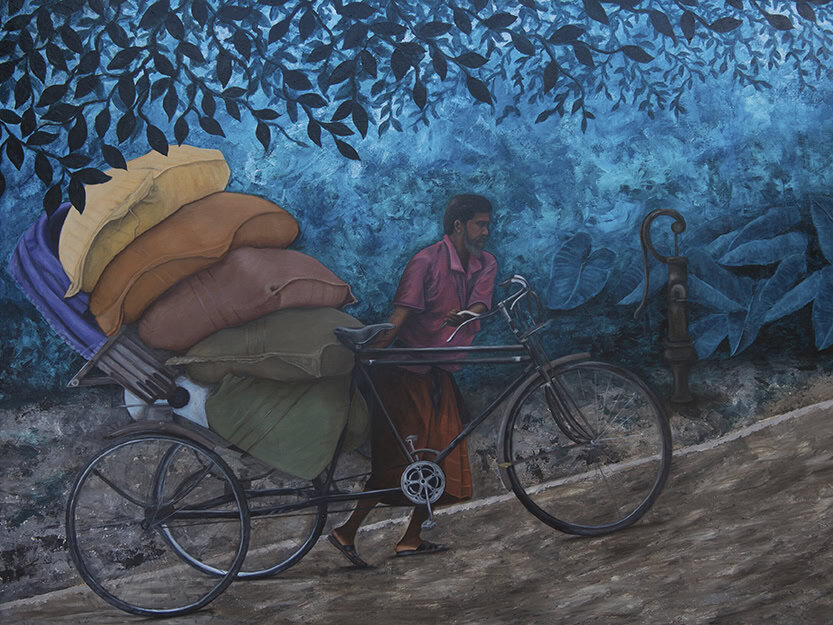
Consider a simple scene of a hardworking man pushing a heavily loaded bicycle. His physical effort, the tension in his body, the tired expression on his face, his clothing, and the surrounding environment can tell a powerful story about everyday life.
When such a moment is captured on a physical canvas, the artwork becomes more than an image. It becomes a visual representation of struggle, culture, humanity, and emotion.
This is where traditional painting continues to hold a special place in the modern world.
Traditional painting is the creation of artwork using physical materials such as oil paints, acrylics, watercolors, or tempera on surfaces including canvas, paper, wood, or other materials.
Unlike digital artwork, traditional painting creates a direct relationship between the artist’s hand, the brush, the pigment, and the physical surface.
Every movement of the brush can influence the final result. The thickness of the paint, the pressure of the brush, the blending of colors, and even unexpected marks can become part of the artwork.
One of the defining characteristics of traditional painting is its physical texture.
Paint can be layered, scraped, blended, or applied with different levels of pressure. These techniques create a surface that can be visually explored from different angles and distances.
The brush marks themselves can become part of the artistic language, giving the painting depth and character.
Traditional painting does not come with an unlimited Undo button.
An artist must make decisions in real time. If a particular stroke does not work, it may need to be painted over, adjusted, or incorporated into the composition.
This limitation can actually become part of the creative process. Mistakes can evolve into unexpected details, while spontaneous decisions can give the artwork a distinctive personality.
A traditional painting exists as a physical object with its own combination of pigments, brushwork, texture, and surface characteristics.
Although photographs and reproductions can capture the appearance of an artwork, they cannot completely reproduce the physical presence of the original canvas.
That uniqueness gives traditional artwork a special place in the world of collecting and fine art.
Great art does not always require extraordinary subjects.
Sometimes, the most powerful stories can be found in ordinary people and everyday moments—a street vendor working through the afternoon, a farmer returning home after a long day, or a laborer struggling to move a heavy load.
Imagine a hardworking man pushing a heavily loaded bicycle down a rough road.
The weight of the load is visible in his posture. His facial expression reflects exhaustion. His clothing connects the scene to a particular culture and environment. The road, surroundings, and atmosphere add another layer to the story.
When an artist captures this moment with physical paint, the artwork can communicate much more than the appearance of the subject.
The rough texture of the canvas can echo the roughness of the road. Strong brushstrokes can reflect physical effort. Darker tones can communicate fatigue, while carefully placed highlights can draw attention to the human figure.
The medium and the subject begin to work together.
The painting does not simply show struggle—it allows the viewer to feel something about it.
Digital artwork is generally viewed through a screen. Traditional painting offers a different kind of experience.
The physical surface of the canvas, the layers of paint, visible brush marks, and the way natural light interacts with the artwork all contribute to its character.
When viewed in a gallery or personal collection, an original painting has a physical presence that cannot be fully experienced through a digital display.
The viewer is not simply looking at an image. They are standing in front of an object created by another human being.
The value of an original painting extends beyond its visual appearance.
It represents the artist’s time, technical ability, creative decisions, and individual expression. The physical artwork itself becomes part of its identity.
Digital files can be reproduced with remarkable accuracy, while an original canvas remains a distinct physical object.
This sense of exclusivity is one reason traditional paintings continue to attract collectors, galleries, museums, and private art enthusiasts.
The original is not merely a copy of an image. It is the actual object created by the artist.
Digital tools allow artists to zoom in, refine tiny details, experiment with unlimited variations, and undo mistakes instantly.
Traditional painting works differently.
A small variation in a brushstroke, an unexpected blend of colors, a visible underpainting, or even a subtle paint mark can remain part of the finished piece.
These imperfections are not necessarily flaws.
They can reveal the process behind the artwork.
They remind us that a real person stood behind the canvas, made decisions, experimented with materials, faced challenges, and gradually transformed a blank surface into something meaningful.
That human process is part of what makes traditional painting special.
Traditional and digital painting should not necessarily be viewed as competitors.
Each medium has its own strengths.
Digital painting provides speed, flexibility, and endless experimentation, while traditional painting offers physical depth, material character, and a direct connection between the artist and the artwork.
Being a traditional artist in the modern age does not mean rejecting technology.
In fact, digital tools can help traditional artists present, preserve, and develop their work without replacing the physical painting process.
Modern audiences are often interested in how an artwork comes to life.
Artists can document different stages of their work—from preparing the canvas and mixing colors to creating the initial sketch and applying the first layers of paint.
Sharing these moments through websites, blogs, and social media can give audiences a deeper understanding of the artist’s creative process.
It also creates a stronger connection between the artist and the viewer.
Physical paintings should be carefully documented before they are sold, exhibited, or moved to another location.
High-quality photography or professional scanning can preserve detailed digital records of the original artwork.
These digital versions can then be used for online portfolios, websites, exhibitions, promotional materials, and high-quality reproductions.
In this way, digital technology can help protect the history of a physical artwork.
Digital technology can also be useful before the painting process begins.
Artists can experiment with composition, lighting, perspective, color combinations, and visual arrangements digitally before committing to a large canvas.
This approach can save time and materials while giving the artist greater freedom during the planning stage.
Technology does not have to replace the brush.
It can simply become another tool in the artist’s creative process.
Digital art has transformed the creative world and demonstrated how technology can expand artistic possibilities.
But traditional painting reminds us that the value of art is not limited to the final image.
A physical painting carries traces of the process that created it—the pressure of the brush, the layers of pigment, the artist’s decisions, the unexpected changes, and the countless hours spent bringing an idea to life.
Every brushstroke can become evidence of human presence.
As technology continues to advance, digital art will undoubtedly become even more sophisticated. New tools, techniques, and creative platforms will continue to emerge.
But the appeal of an original painting is unlikely to disappear.
Because a screen can display an image, while a physical canvas can preserve something deeper—the artist’s time, touch, effort, emotion, and presence.
Traditional painting is not simply an older form of art. It is a lasting reminder that some forms of creativity are meant not only to be seen, but also to be experienced.